Losing Track of Time? Time Tracking Turns Guesswork into Insight.

"I was busy all day, but I don't know what I actually finished."
If you've ever said this, you're not alone.
Many professionals start their day with a long to-do list, answer emails, attend meetings, reply to messages, and switch between multiple projects. By the end of the day, they feel exhausted—but when they look back, they struggle to explain where their time actually went.
This is one of the biggest productivity challenges today.
The problem isn't always a lack of effort. More often, it's a lack of visibility.
Time tracking changes that.
Instead of guessing how your day was spent, you get real data. You discover which tasks deserve more attention, which activities waste your time, and how you can work smarter instead of simply working longer.
Today, AI-powered project management tools make time tracking even more valuable. They don't just record hours—they help you understand your work patterns, improve productivity, and make better decisions.
Let's explore how.
Why Time Tracking Matters More Than Ever
Time is one resource you can never recover.
Money can be earned again. Projects can be restarted. Opportunities can come back.
But every minute that passes is gone forever.
Many teams believe they know how their time is spent. In reality, interruptions, unnecessary meetings, repeated revisions, and constant task switching consume hours every week.
Without tracking time, businesses often face problems like:
Missing project deadlines
Poor workload planning
Unbalanced teams
Budget overruns
Employee burnout
Lower productivity
Time tracking replaces assumptions with facts.
Instead of saying, "This project took longer than expected," you know exactly why it happened.
What Is Time Tracking?
Time tracking is the process of recording how much time is spent on different tasks, projects, clients, or activities.
It gives individuals and teams a complete picture of where their working hours go.
Modern time tracking tools go far beyond simple timers.
They automatically organize work, connect tracked time to projects, generate reports, estimate future workloads, and even use AI to identify productivity trends.
Instead of manually filling out timesheets every Friday, professionals can now capture their work automatically.
out
Why Do People Lose Track of Time?
Before solving the problem, it's important to understand why it happens.
Some common reasons include:
Constant Context Switching
Replying to emails.
Then joining a meeting.
Then answering Slack messages.
Then, returning to your report.
Every switch costs focus.
Underestimating Small Tasks
A "quick" email becomes twenty minutes.
A five-minute meeting turns into forty.
Tiny tasks quietly consume hours.
Too Many Meetings
Meetings are necessary.
Unnecessary meetings are expensive.
Without tracking time, organizations rarely realize how much productive work disappears into discussions.
No Clear Daily Plan
When priorities aren't defined, people jump between urgent requests instead of focusing on important work.
Manual Work
Repeated administrative tasks steal valuable time that could be automated using AI.
How Time Tracking Improves Productivity
Many people think time tracking is only about recording working hours. In reality, it is much more than that. It helps individuals and teams understand how they spend their time, identify areas for improvement, and make smarter decisions. Instead of relying on assumptions, businesses use real data to improve efficiency, reduce wasted effort, and complete projects on time.
Here are some of the biggest ways time tracking improves productivity.

Better Focus
One of the biggest productivity challenges today is distraction. Emails, messages, meetings, and unexpected requests can interrupt your workflow several times a day. These interruptions make it difficult to stay focused on important tasks.
Time tracking creates awareness. When people can clearly see how much time they spend on different activities, they become more mindful of their work habits. They start reducing unnecessary distractions, avoid multitasking, and dedicate more uninterrupted time to high-priority tasks.
Many AI-powered time tracking tools also provide reports that show where time is being lost. This allows users to make small adjustments that can significantly improve daily productivity.
More Accurate Planning
Estimating project timelines without real data often leads to missed deadlines and unrealistic expectations. Teams may believe a project will take five days, only to discover later that it actually requires two weeks.
Time tracking solves this problem by providing historical data from previous projects. Managers can review how long similar tasks took in the past and use that information to create more accurate schedules and resource plans.
With AI-powered project management tools, this process becomes even smarter. AI can analyze past project data, identify patterns, and suggest realistic deadlines based on actual team performance. This helps organizations reduce delays and improve project delivery.
Smarter Workload Distribution
Not every employee has the same workload. Some team members may be handling multiple urgent projects at once, while others have extra capacity that goes unnoticed.
Time tracking gives managers a clear view of how work is distributed across the team. They can quickly identify:
Employees who are overloaded with too many tasks
Team members who have available capacity
Projects that are consuming more time than expected
Departments that need additional support
This information helps managers assign work more fairly, prevent employee burnout, and ensure projects move forward smoothly. Balanced workloads also improve job satisfaction because employees feel their responsibilities are manageable and fairly distributed.
Improved Profitability
For agencies, consultants, freelancers, and service-based businesses, every working hour has financial value. Without accurate time records, it becomes difficult to understand the true cost of delivering a project.
Time tracking provides valuable insights that directly impact profitability by helping businesses:
Bill clients accurately based on actual hours worked
Create more realistic project estimates for future clients
Identify tasks that consume unnecessary time
Reduce project overruns that affect profit margins
Improve pricing strategies using real performance data
When businesses understand exactly where their time is invested, they can make informed decisions that increase revenue while controlling costs.
Better Decision-Making with Real Data
Successful businesses rely on facts, not assumptions. Time tracking provides reliable information that supports smarter business decisions.
Instead of asking questions like, "Why are we missing deadlines?" or "Why is this project costing more than expected?", managers can review time reports to identify the exact causes.
AI-powered analytics make this process even more powerful by highlighting trends, predicting future workloads, and recommending areas for improvement. These insights help organizations make faster and more confident decisions.
Higher Team Accountability
Time tracking encourages transparency without creating unnecessary pressure. Every team member understands how their work contributes to the overall project, making it easier to stay responsible for assigned tasks.
When progress is visible, teams communicate more effectively, identify delays earlier, and collaborate to solve problems before they become major issues. This creates a culture of ownership and continuous improvement.
Continuous Improvement
One of the greatest advantages of time tracking is that it helps organizations learn from every project they complete.
Each completed project becomes a valuable source of information. Teams can review what worked well, identify where extra time was spent, and improve their processes for future projects.
Over time, these small improvements lead to significant gains in productivity, efficiency, and project quality. Combined with AI-powered reporting and recommendations, businesses can continuously refine their workflows, eliminate repetitive tasks, and achieve better results with less effort.
Rather than simply measuring time, modern time tracking transforms everyday work into actionable insights that help individuals and organizations become more productive with every project they complete.
AI Is Changing the Way We Track Time
Traditional timers only answer one question:
"How much time did I spend?"
AI answers much bigger questions.
For example:
Why did this project exceed its estimate?
Which tasks consume the most effort?
Which employees are overloaded?
Which recurring tasks should be automated?
How can next month's schedule improve?
Instead of just collecting data, AI turns information into recommendations.
That's where modern project management platforms become powerful.
ClickUp: The Complete AI-Powered Productivity Platform
When discussing productivity, many people think of time tracking as a separate activity.
ClickUp changes that completely.
Instead of using multiple apps for task management, time tracking, documentation, AI assistance, reporting, and collaboration, ClickUp combines everything into one workspace.
That is why thousands of organizations use it to manage their daily operations.
Built-in Time Tracking
ClickUp allows users to start and stop timers directly from their tasks.
Every minute automatically connects to the correct project.
No manual calculations.
No separate spreadsheets.
No forgotten timesheets.
Whether you're working alone or managing a large team, every hour becomes visible.
AI Makes Time Tracking Smarter
ClickUp AI goes beyond recording time.
It helps users understand their work.
AI can:
Summarize long project updates
Generate meeting notes
Create task descriptions
Write project documentation
Suggest priorities
Identify project risks
Speed up communication
Reduce repetitive work
Instead of spending time organizing work, AI helps you complete it faster.
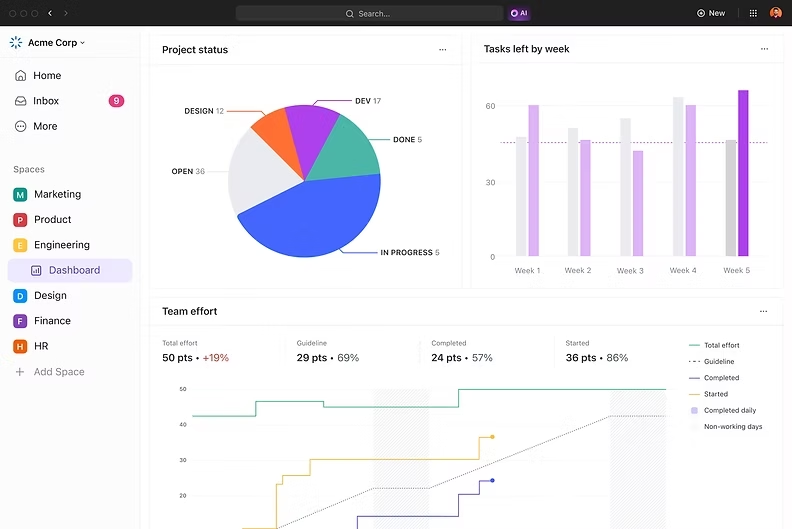
Real-Time Productivity Insights
Managers no longer wait until the end of the month.
ClickUp dashboards show live information including:
Team workload
Time spent per project
Project progress
Resource allocation
Task completion rates
Bottlenecks
Better visibility leads to better decisions.

Automate Repetitive Work
Every repetitive task costs time.
ClickUp Automations reduce manual work by automatically:
Assigning tasks
Updating statuses
Sending reminders
Moving projects between stages
Notifying team members
Creating recurring tasks
The result?
Less administration.
More meaningful work.

AI Documentation Saves Hours
Many professionals spend hours writing reports, project updates, meeting summaries, and SOPs.
ClickUp AI generates these within seconds.
Teams spend less time documenting work and more time completing it.

Collaboration Without Switching Apps
ClickUp combines:
Tasks
Chat
Documents
Whiteboards
Dashboards
Goals
Time tracking
AI
Everything stays connected inside one workspace.
This reduces app switching and saves valuable time every day.
Better Decision Making Through Data
Guesswork disappears.
Managers know:
Which projects are profitable
Which clients consume extra effort
Which teams need support
Where productivity drops
Which processes need improvement
Every decision becomes data-driven.
If you want to learn more about ClickUp and Productivity Management, you can connect with ME on LinkedIn.
Comparison with Other Time Tracking Tools
Many popular productivity platforms provide time tracking features. Some focus mainly on recording hours, while others specialize in invoicing, employee monitoring, or simple project management.
Although these tools perform well in their own areas, they often require additional software for documentation, AI writing, reporting, automation, communication, or project planning.
ClickUp takes a different approach.
Rather than asking teams to connect several separate tools, ClickUp brings everything together in one platform. Its built-in AI, advanced automations, dashboards, documents, goals, collaboration features, and project management capabilities create a complete productivity system instead of just a time tracker.
For organizations that want to simplify their workflow while using AI to improve planning and execution, ClickUp offers far greater long-term value than relying on multiple disconnected applications.
Here's the full Comparison of ClickUp with other tools.
Common Mistakes to Avoid When Tracking Time
Many people start tracking time but don't use the information effectively.
Avoid these mistakes:
Tracking only part of your workday
Forgetting to categorize tasks
Ignoring reports
Measuring hours instead of outcomes
Not reviewing productivity trends
Tracking manually when automation is available
The goal isn't simply collecting data.
The goal is to improve how you work.
Small Habits That Save Hours Every Week
Simple habits can dramatically improve productivity.
Try these:
Plan tomorrow before ending today.
Review your tracked time every Friday.
Automate repetitive tasks.
Group similar work together.
Reduce unnecessary meetings.
Use AI to summarize documents and meetings.
Focus on one important task at a time.
Track time consistently.
Small improvements create big long-term results.
Turn Every Hour into Better Decisions
Most people don't waste time intentionally.
They simply don't see where it goes.
Time tracking gives you that visibility.
When combined with AI, it becomes much more than a timer—it becomes a decision-making tool.
Instead of reacting to problems after deadlines are missed, you can identify issues early, improve team performance, plan projects more accurately, and make every working hour count.
If your goal is to build a more productive team, reduce manual work, and use AI to manage projects intelligently, ClickUp is one of the strongest platforms available today.
At ITSARKAR, we help businesses implement AI-powered project management systems that improve productivity, automate repetitive work, and streamline daily operations using ClickUp.
If you'd like personalized guidance on setting up ClickUp, automating your workflows, or using AI to improve your team's productivity, book a one-on-one strategy session with Yasir Ali Warraich today. Let's build a smarter way to work together.


Comments